

Italy held referendums on 8-9 June on five questions. The first four questions related to various labour rights; aiming to overturn the liberalisation of labour markets introduced by Matteo Renzi. The fifth question was on the citizenship law, which would allow foreign residents to apply for Italian citizenship after 5 years of residency rather than 10.
These were “abrogative” referendums, whereby the Italian constitution provides for a popular vote to overturn an existing law. These types of referendums can be proposed by at least five Regional Councils or at least 500,000 Italian voters. These referendums only pass, though, if at least 50%+1 participate in a vote and a majority of those participating vote “Yes”.
The referendums all failed this time because there was only a 30% turnout in the vote. The main reason for this low turnout was that the three right-wing parties in government (Fratelli d’Italia, Forza Italia, and Lega) called on their voters to boycott the votes (although Italian prime minister Giorgia Meloni did turn up at her local polling station, to emphasise that she was going to “abstain” rather than take part).
This dismal turnout, voiding the five referendums, was a major defeat for the parties on the left – who promoted the five issues – and a victory (or at least bragging rights) for the parties on the right, and Meloni in particular.
But, wait! That’s not the end of the story. As the results came in on Monday evening, the balance of Yes and No votes across the country appeared to tell a more nuanced story about Italian politics.
To start with, there was considerably difference in the per cent of Yes votes across the five referendums: between 86% and 88% on the four labour rights issues, and only 65% on the citizenship issue. This suggests that there was a different structure of voter preferences on labour rights (an issue related to the classic economic left-right dimension of politics) as opposed to citizenship rights (an issue which these days is related to the “second”, social or cultural, libertarian-authoritarian dimension of politics). An additional piece of evidence pointed in this direction was the geographic pattern of per cent Yes votes on the four issues; with some provinces voting more for labour rights than citizenship rights, and other provinces voting the other way round.
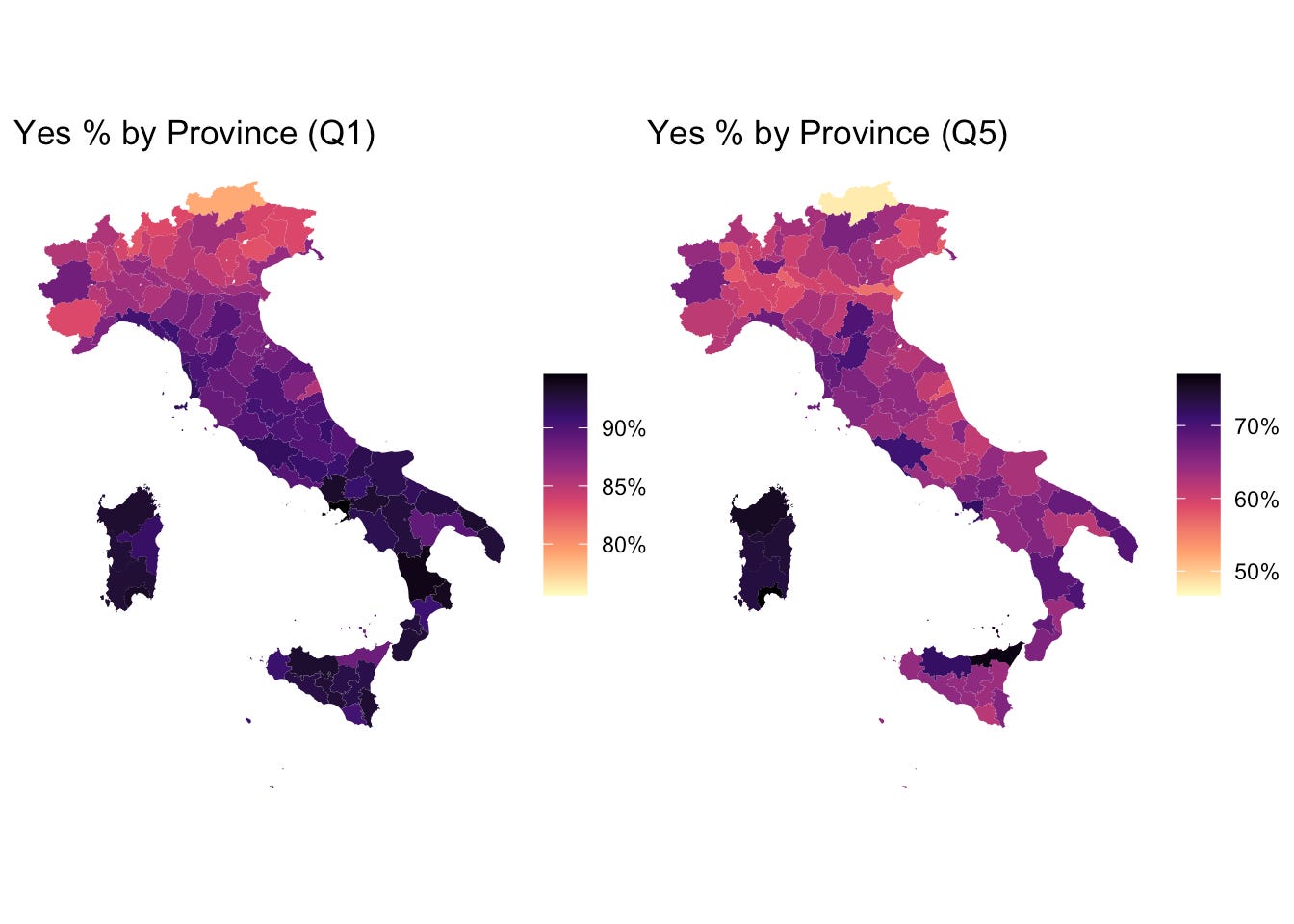
This is illustrated in the following figure, which shows the per cent of Yes votes in each Italian province for Question 1 (on labour rights) and Question 5 (on citizenship rights). On question 1, the shading suggests that the further south a province is, the more it supported labour rights. On question 5, in contrast, the pattern is more mixed, with cities and the “red belt” of Tuscany and Emilia-Romagna, as well as Sardegna, more supportive than either the southern or northern provinces.
To investigate this intuition a bit more systematically, we estimated a simple principal-components analysis of the per cent Yes votes in the five referendums, at both the municipality and province levels. As we suspected, this revealed that the pattern of votes (at least geographically) was indeed two-dimensional, with the variations in the per cent Yes votes on the four labour rights questions loading on the first dimension, and the variations in the per cent of Yes votes on the citizenship rights question loading on a second dimension.
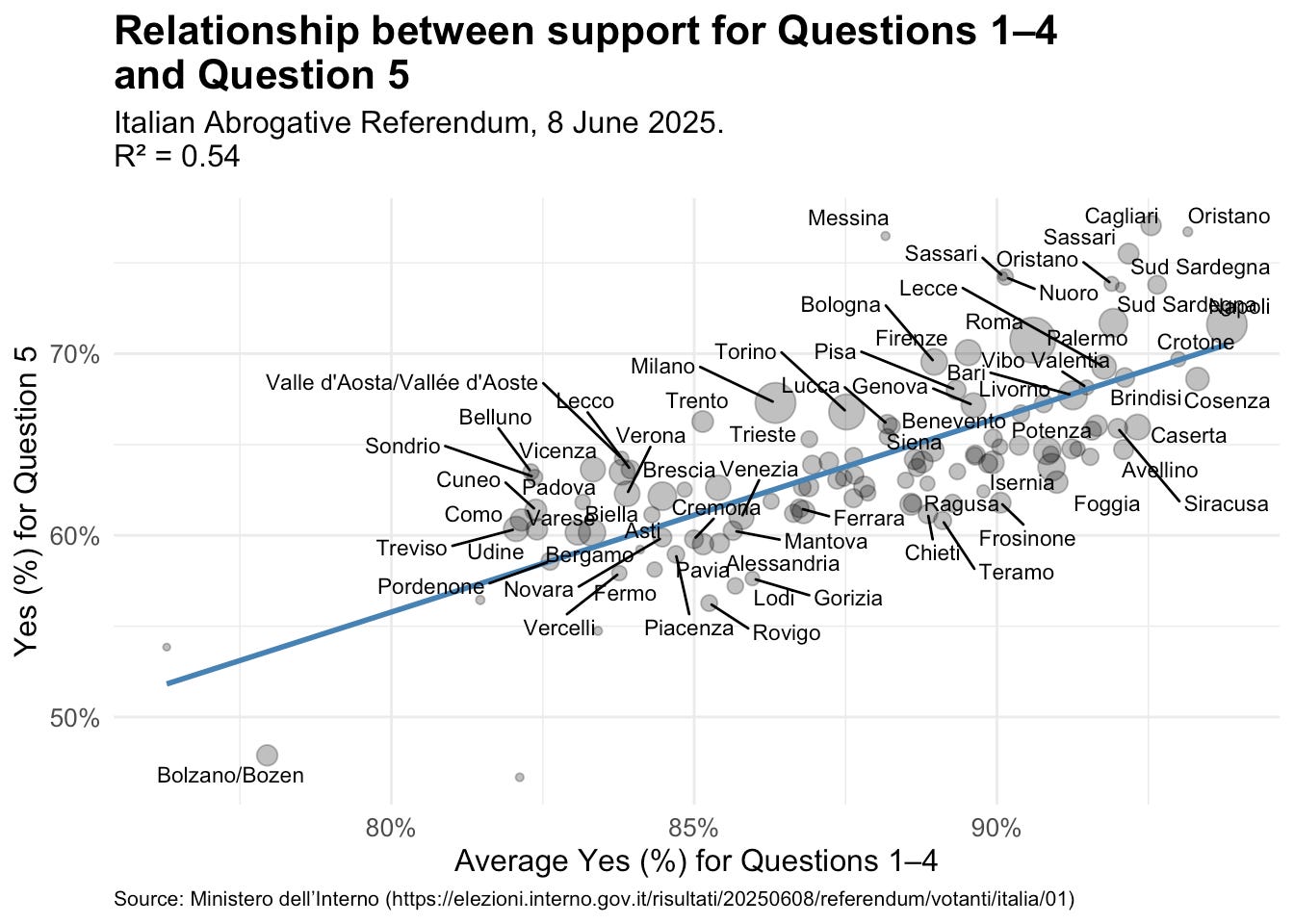
This two-dimensional picture is illustrated in this next figure. Here we plot the mean per cent Yes at the province level on the four labour rights issues against the mean per cent Yes on the citizenship rights question (with the population size of each province indicated by the size of the circles).
This figure shows that there was a correlation between the two sets of issues. In the “bottom left” corner of the plot are the most “right-authoritarian” provinces, in particular Bolzano (in South Tyrol), with low levels of support for both set of issues. In the “top right” corner are the most “left-libertarian” provinces, such as Naples, with strong support for both sets of issues. And, many of the other provinces are located at some point “on the line” between these two extreme positions.
Nevertheless, several provinces are not located “on the line”, which means that their voting behaviour did not fit a simple right-authoritarian vs. left-libertarian structure. For example, Rome, Florence and Bologna were all relatively more supportive of citizenship rights than of labour rights (so more libertarian and slightly less left), while Ragusa (in Sicily), Frosinone (in Lazio) and Teramo (in Abruzzo) were relatively less supportive of citizenship rights than of labour rights (so more authoritarian and slightly less left).
So, what can we take away from this simple analysis? First, Italian politics, like the politics of many advanced democracies, is now multidimensional. Second, given this, the effort by the left, and particularly the Partito Democratico, to combine the two sets of issues in a single set of referendums might have backfired.
In some contexts, combining issues can help build a majority-winning coalition: what political scientist call “log-rolling”, where one group supports another group’s position on an issue, in return for their support on a different issue. However, in other contexts, combining issues in a single vote can also lead to defeat, by dividing the majorities on each of the underlying issues, and by mobilising forces opposed to either issue to vote together against both of them (in fact, William Riker built a whole theory of legislative politics from this intuition). This seems to have happened in this case: where the right-wing parties in Italy where able to mobilise people to boycott all of the votes if they opposed either more labour rights or more citizenship rights.
Put another way, by separating labour rights from citizenship rights, more voters might have been mobilised in each issue separately. Separating the issues might have enabled left-libertarians to attract left-authoritarians to support more labour rights, and left-libertarians to attract right-libertarians to support more citizenship rights. Instead, by combining the issues, right-authoritarians successfully corralled right-libertarians (who dislike more labour rights) and left-authoritarians (who dislike more citizenship rights) to pre-commit to abstain, and so defeat both sets of initiatives.
This is speculation, of course, but does suggest that different strategies might be considered in future referendums promoted by progressive forces in Italian politics.

In the bullets-by-province graphic, some provinces are mentioned twice. I noticed it while searching for the Sardinian provinces in the upper right corner.
Why does Sardinia vote so “left” on the fifth question?
Very interesting !!